In this tutorial, You have learned about the python list insert() method to add the elements to list at a specific position or index number. The python list insert() method is used to insert an element at a specific position in a list. If you need to add an item to the specific position then use the insert method.

Before we proceed, here's a quick refresher on python lists – Lists are used to store an ordered collection of items. These items can be any type of object from numbers to strings or even another list. This makes lists are one of the most versatile data structures in python to store a collection of objects.

For more, check out our guide onlists and other data structures in python. The list insert function is a built-in list function which is used to insert the element on a specific position in the list. Lists are quite useful when it comes to storing sequences or collections and are frequently used in python. It may happen that you want to add elements to an existing list.

To do so, the list functions append(), extend(), and insert() are commonly used. We see that of the three methods, append is the quickest. To see the difference between the extend and append methods, see the following example.
Then, I used the append and extend methods to add one list to the other. In certain scenarios, you need to add the items in existing list to the specific position rather than at the end of a list. For that, you may use the Python insert method of the list. For example, we'll insert an element into an existing list of size 5. Python has a few methods to add items to the existing list.
Each of these methods is explained below with examples. This tutorial will discuss how to use the Python insert() method to add an element to a list at a specific position. We'll walk through an example to help you get started with this method. The insert method adds new element x at position i in the list. It shifts all subsequent elements one position to the right.

The insert method inserts an element x at position i in the list. This way, you can insert an element to each position in the list—even at the first position. Note that if you insert an element at the first position, each subsequent element will be moved by one position. The first two methods above dealt with a single object being added into a python list. So, this approach to insert item into python list is a bit different as it deals with an iterable list.
Like the append function, the extend function is a cleaner and more readable way to add the individual elements of an iterable to a list. In this example, a list of numeric objects is created. After that, an item is added to the list by using the append method. You have to provide the object as a parameter in the append method.
The append method updates the given list and does not return any value. But both those methods add items to the end of an existing list and cannot be used to insert items at a specific index position. The Insert function is a built-in list method that allows you to insert items or objects at any position in a sequence.

The insert() method in Python inserts an element to the list at the specified index. These are the position of the new item and the value of the new item we want to add to our list. This method is similar to the Python append() method, which also adds an item to a list. However, while append() adds an item to the end of a list, insert() adds an item to a list at a specific position. The Python insert() method adds an element to a specific position in a list. Insert() accepts the position at which you want to add the new item and the new item you want to add as arguments.

Here's the resulting plot that compares the runtime of the two methods append() vs extend(). On the x axis, you can see the list size from 0 to 1,000,000 elements. On the y axis, you can see the runtime in seconds needed to execute the respective functions.
Then, I created 100 lists with both methods, extend() and append(), with sizes ranging from 10,000 elements to 1,000,000 elements. As elements, I simply incremented integer numbers by one starting from 0. The insert() function inserts an element to the given index of an existing list. It accepts two parameters, the index to be inserted into and the value to insert. In the above example, we see how the append function is applied. We append the element x to the list ls1 using the append() function and compare the results from its equivalent operation using slicing and assignment.

Append is a built-in list function and is actually a cleaner way to add items to the end of the list. In this article we will discuss how to insert an element in list at specific position. Method is a list built-in method that is used to add an element at the specific position or index number in the existing list. Sometimes we need to insert a specific element on a specific position, Then we have the best list method insert() to perform that operation.

Here, output returns updated list with inserted value. Python list insert() method It inserts passed object into a given list at given index and returns updated list. Python list insert function is used to insert elements in List.

The Python insert() method adds item to a list at a specific position in a list. These are the position of the new item and the value of the new item you want to add to your list. Similarly, you can use the insert() method to add numbers, booleans, Python tuples, and other data types to a list. The list.insert method inserts an element to the end of the list before the given index position.

In the code, you first add integer elements 1 and 2 to the list using two calls to the append() method. Then, you use the extend method to add the three elements 3, 4, and 5 in a single call of the extend() method. A set is an unordered collection with no duplicate elements. Basic uses include membership testing and eliminating duplicate entries.

Set objects also support mathematical operations like union, intersection, difference, and symmetric difference. It is not possible to assign to the individual items of a tuple, however it is possible to create tuples which contain mutable objects, such as lists. Of course, many more variations may exist for adding items into a python list, but for now, we focus on the above main methods.
If you add list1 + list2 together, then it concatenates all the elements from list2 after the last element of list1. For example, let's add a single integer into the beginning of an already existing list using the + operator. In this post, you will learn how to insert an element at a specific position or location, or Index in a Python list. The extend method of the list allows appending the items of a sequence to the given list. So, if you want to add more than one item at one call, you may use the extend method. To insert an element in any position in a list we use the insert method.
Python list.insert method inserts the element at a given index in the list. Another approach is to convert the element to be inserted into the list and append it into the existing list. This solution creates a new list and often performs slower than the above solution. Like the append() method, insert() adds an item to a list. But, you cannot specify the position of the new item using the append() method.

But, we could use the insert() list method to add any type of data instead. However, the effect only plays out for very large lists. Well, for clarity of your code, it would still make sense to prefer extend() over append() if you need to add a bunch of elements rather than only a single element. You want to insert elements 42 and 99 at position 2 of the list lst, in that order. If you'd just iterate over both elements, you'd first insert element 42 before index 2. So basically, you've reversed the original order of the elements to be inserted.

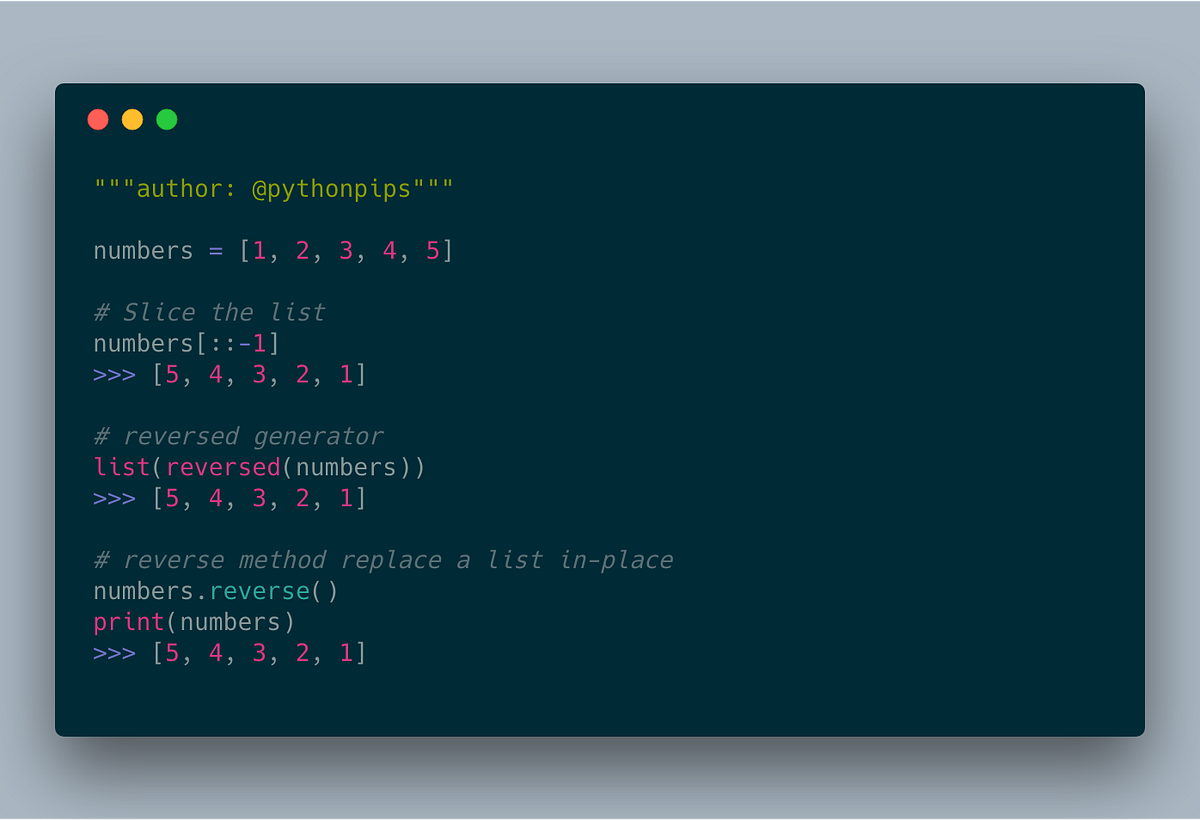
Therefore, you have to call the reverse() method first before inserting the elements into the list. This is the other method you can use to add item to python list. Even though a python list can have items of different types, it is mostly advisable to have a list contain related types only. Arrays otherwise known as lists in python are common data structures in python. Python list contains items and it can be modified by adding more items to it. We typically use list() to create lists from existing iterables such as strings, dictionaries, or tuples.

In this tutorial, we shall learn how to insert an item in a list, at given position, with the help of example Python programs. To insert or add an item at specific position or index in a list, you can use insert() method of List class. Notice the to_insert variable is encapsulated with square brackets []. This is done to convert the single integer into the list data type to make list addition possible. In the above example, we apply the append function on ls1 and the extend function on ls2.

The append function simply appended as an object to the list ls1, while the extend function added each element of to the list ls2. The for/in constructs are very commonly used in Python code and work on data types other than list, so you should just memorize their syntax. You may have habits from other languages where you start manually iterating over a collection, where in Python you should just use for/in. The time complexity to insert an element at a given index is O. This means that the complexity increases linearly with the number of elements in the list. We have shown you the different methods to add an element at the front of the list.

We have seen different methods, such as Insert, Addition (+) Operator, Slice, and Unpacking Asterisk. All the methods are very easy to use, but along with that, we also have to care about the processing time. Because if the data is less, we may not care about it. However, if we have billions of data, then it might matter. Based on this premise, the Insert Method is the best method in processing. In this tutorial, we will learn about thePython list insert()method with the help of examples.

When the user calls the insert method and passes the index, the function first checks its existence in the list. We use the insert() method to add the Starling to our list of birds. Because we want to add our bird to the start of our list, we specify the index parameter 0. This adds the value Starling to the start of our list.

By using the list concatenation operation, you can create a new list rather than inserting the element into an existing list. For large lists with one million elements, the runtime of the extend() method is 60% faster than the runtime of the append() method. The difference between append() and extend() is that the former adds only one element and the latter adds a collection of elements to the list. However, the computational complexity of the naive sorted insert algorithm is bad because you need up to n operations to insert an element into a list of n elements. However, this doesn't make a lot of sense considering that you can use the append method which adds an element at the end of the list—and is highly efficient .

Read more about the append() method at my detailed blog article. The insert method can also insert set and tuples into a list. List comprehensions provide a concise way to create lists. While appends and pops from the end of list are fast, doing inserts or pops from the beginning of a list is slow . There is nothing as common as sorting when it comes to working with data. This tutorial will give you two part guide on how to sort python list.

We will use negative indexes like -1 and -2 as the index parameter which will insert the elements to 2nd last and 3rd last position of the list. We will pass a string value as the given element with index parameter 2, So insert() method will insert the string value at the 3rd position of our list. If we will try to insert an element in the string we will get an error because string value does not have any insert() function. In this tutorial of Python Examples, we learned how to insert an item at given position in the list. Another approach to append an element to the front of a list is to use the + operator. Using the + operator on two or more lists combines them in the specified order.

Index – The index number where you want to insert an item or element. And the existing elements listed after the specified index will be shifted to the right after the new element. List.pop -- removes and returns the element at the given index. Returns the rightmost element if index is omitted (roughly the opposite of append()).

If you know what sort of thing is in the list, use a variable name in the loop that captures that information such as "num", or "name", or "url". Since Python code does not have other syntax to remind you of types, your variable names are a key way for you to keep straight what is going on. The x is an object or item to be added to the specific position in the list. Is an inbuilt method in python, which is used to add an element /item at specified index to the list. In this post, you will learn how to insert an element into a list in a specific location. In this Python Tutorial, we have learned the syntax of list.insert() method and its usage with the help of example programs.


